AI Crawler & Bot Traffic Analysis: How to See What GPTBot, ClaudeBot, and Perplexity Are Doing on Your Site
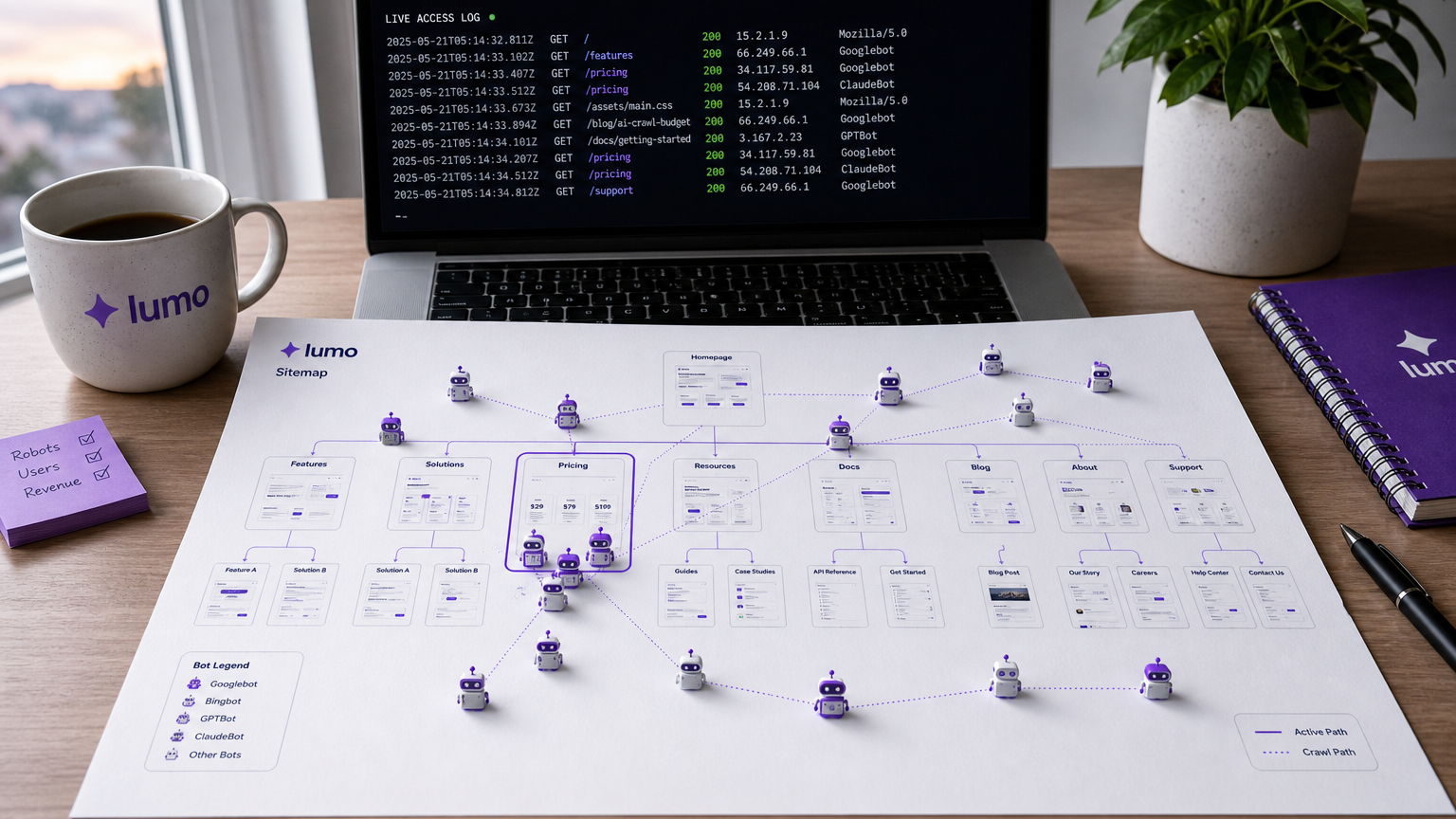
Most teams can tell you their organic traffic down to the session, but ask them how often GPTBot hit their pricing page last month and you’ll get a shrug. That blind spot is becoming a real business risk as more discovery happens inside AI answers instead of search results.
What is AI crawler and bot traffic, and why does it matter now?
AI crawlers are a distinct category of bot traffic, separate from both traditional search engine crawlers and malicious scrapers, even though they can look similar in a raw access log. Search engine bots like Googlebot exist to build a search index and rank pages. Malicious scrapers exist to harvest content, pricing, or contact data, often while masking their identity. AI crawlers sit in a different lane: they exist to feed large language model training sets or to power real-time retrieval for answer engines that generate conversational responses instead of a list of links.
That distinction matters because of what happens downstream. When GPTBot or ClaudeBot pulls a page, that content may become part of a training corpus, shaping how a model responds to future queries for months or years. When PerplexityBot or a retrieval-augmented system fetches a page in real time, that content can be summarized, quoted, or cited within seconds, directly inside an answer a prospect is reading right now. In both cases, whether your brand shows up depends on whether these bots can reach your content and what they find when they do.
This is the mechanism behind a broader shift that most marketing teams feel but haven’t fully named yet: the move from “rank in search” to “get cited in answers.” Ranking is about winning position on a results page a human will scan. Citation is about being the source an AI system chooses to quote or paraphrase when someone never sees a results page at all. Crawler traffic is the earliest, most concrete signal you have of whether you’re even in the running for that citation.
Which AI bots should you be tracking?
A working watchlist should cover the major named bots and what each one actually powers. GPTBot is OpenAI’s crawler, primarily used to gather training data for future model versions, though OpenAI also operates separate agents for real-time browsing. ClaudeBot is Anthropic’s crawler, serving a similar training-data role. PerplexityBot is more retrieval-oriented, frequently fetching pages to generate live, cited answers rather than purely training a model offline. Google-Extended is Google’s control mechanism specifically for whether your content can be used in Gemini and AI Overviews, separate from standard Googlebot indexing for search results. Rounding out the list, Bingbot feeds Microsoft’s search index and Copilot, while CCBot, run by Common Crawl, produces a widely reused open dataset that multiple AI labs train on, meaning your exposure to it has downstream effects well beyond one company.
Two things make this list a living document rather than a one-time reference. First, user-agent strings and crawler behaviors change as providers ship new versions, split out new agents, or adjust crawl patterns, so a bot list from even six months ago may already be incomplete. Second, compliance with robots.txt is inconsistent across this category. Some crawlers reliably respect disallow directives; others have been reported to crawl regardless, or to use secondary user agents that don’t match the one you’ve blocked. Treat your bot watchlist the way you’d treat a threat list in security: reviewed and updated on a cadence, not filed away after the first read.
How do you actually analyze AI crawler traffic on your site?
The most reliable method is log-file-based analysis, and it’s reliable for a specific reason: most AI crawlers don’t execute JavaScript, so any analytics platform that depends on a JS tag firing in a browser simply never sees them. Your server logs, on the other hand, record every request regardless of whether a script ran, which makes them the only complete source of truth for this kind of traffic.
A practical workflow starts with filtering raw logs by known user-agent strings for each bot on your watchlist, then grouping hits by bot to see relative crawl volume. From there, track three things over time: crawl frequency (is GPTBot visiting daily, weekly, or not at all), which URLs get crawled (are your money pages being reached, or just your blog), and the status codes returned (repeated 404s or 500s on crawled paths mean a bot is hitting broken links, which wastes crawl activity and signals a technical problem worth fixing).
If you don’t have direct server log access, CDN and edge-network bot dashboards are a solid alternative. Providers like Cloudflare expose bot analytics that classify and report on verified crawlers, including many of the AI-specific ones, without requiring you to parse raw logs yourself.
Watch for two common pitfalls regardless of which method you use. Spoofed user agents mean that not every request claiming to be GPTBot actually is; serious analysis cross-references the claimed user agent against the requesting IP ranges where possible. And it’s easy to conflate legitimate AI crawlers with generic scrapers or bot traffic that has nothing to do with answer engines, which muddies your data and can lead you to over-block or under-block based on a false read.

What should you do with the data once you have it?
Raw crawl logs are only useful once you turn them into a diagnostic. Start by identifying which content sections get crawled most and least, then cross-reference that against how visible your brand actually is in AI answers for those same topics. A section that gets crawled heavily but never shows up in AI-generated answers is telling you something different than a section that’s barely crawled at all: the first is a content or authority problem, the second is an access problem.
Those crawl gaps should directly prioritize your content and technical roadmap. If bots aren’t reaching key pages, look at internal linking structure, XML sitemaps, and whether structured data and schema markup are in place to help crawlers understand what a page is actually about. An emerging piece of this toolkit is llms.txt, a proposed standard for signaling to AI crawlers which content on your site is most relevant and how it should be interpreted, similar in spirit to how robots.txt has long governed search crawler access.
Which brings up the core decision every site now has to make deliberately: blocking, allowing, or selectively guiding AI crawlers via robots.txt directives. Blocking everything protects content from training use but forfeits any chance of citation in real-time answer engines. Allowing everything maximizes exposure but gives up any control over what gets emphasized. The more strategic middle path is selective guidance: using robots.txt and llms.txt together to steer crawlers toward your most authoritative, differentiated content and away from thin or duplicate pages that add no value to an answer engine’s judgment of your site.
How does this connect to winning AI answers, not just tracking visits?
Here’s the part that most crawler-traffic guides stop short of: crawl access is necessary but nowhere near sufficient. A page can be crawled constantly by every major AI bot and still never get cited, quoted, or surfaced in a single generated answer. Getting crawled means a bot could see your content. Getting cited means a model decided your content was the best available source to draw from. Those are very different bars, and conflating them is why so many teams feel like they’re “doing AI SEO” while seeing zero movement in actual answer visibility.
This is why crawler analysis should be treated as a diagnostic step feeding into a content and voice strategy, not a standalone reporting exercise you run once a quarter and file away. The data tells you where you have access problems versus where you have quality problems, and those require different fixes. Access problems get solved with the technical levers above. Quality problems get solved by producing content distinctive and well-sourced enough that a model prefers it over the dozens of other pages saying the same generic thing on the same topic.
That’s the pattern worth internalizing: generic, undifferentiated content gets crawled just fine, because crawling is cheap and indiscriminate, but it rarely gets cited, because answer engines are optimizing for the response that best serves the user, not the response that merely exists. If your content reads like everyone else’s content, the crawl was wasted effort regardless of how often it happened.
What tools and workflows make this sustainable for a lean team?
Manually grepping server logs for user agents works exactly once, as a proof of concept. It does not survive contact with a real content calendar, a growing site, or a marketing team without a dedicated engineer on call every time a new bot shows up. The realistic choices are manual log analysis, a CDN or platform dashboard, or a connected system that treats this as ongoing monitoring rather than a periodic audit.
The argument for the ongoing, inspectable system over the one-off audit isn’t about tooling preference, it’s about the pace of change in this space. Bot behavior shifts, new crawlers launch, answer engine algorithms update, and a static PDF report from last quarter tells you nothing about what’s happening on your site this week. Whatever the exact trajectory, the direction is not in question, and a monitoring cadence built for last year’s bot landscape will already be behind.
This is also where the crawler-data problem connects back to what actually gets published. A lot of existing advice on this topic stops at either a listicle of “top bots to know” with no workflow attached, or a CDN and security vendor’s pitch to just block AI crawlers to save on bandwidth and protect content from training use. Both leave you with information and nothing to do with it. The more useful frame is that crawler insight is only valuable if it feeds directly back into what your team writes next: if a topic cluster is getting crawled but never cited, that’s a signal to revisit the voice, structure, and sourcing of that content, not just a line in a monthly report. That feedback loop is exactly why MarketingCore is built around a versioned voice profile and an inspectable second brain rather than a generic content generator: crawler diagnostics mean something when there’s a real knowledge base for that insight to inform, and a human approval gate to make sure what gets published in response is actually distinctive rather than one more generic page for a bot to crawl and forget.
Treat crawler traffic the way you’d treat any other diagnostic signal: worth collecting continuously, worth acting on quickly, and worthless if it doesn’t change what you produce next. The teams that win AI-answer visibility won’t be the ones with the longest bot watchlist or the strictest robots.txt file: they’ll be the ones who closed the loop between what gets crawled and what gets written.
Get off the content treadmill
Early access is rolling out in small batches — your market intelligence starts compounding the day you plug in.
Join the waitlist